

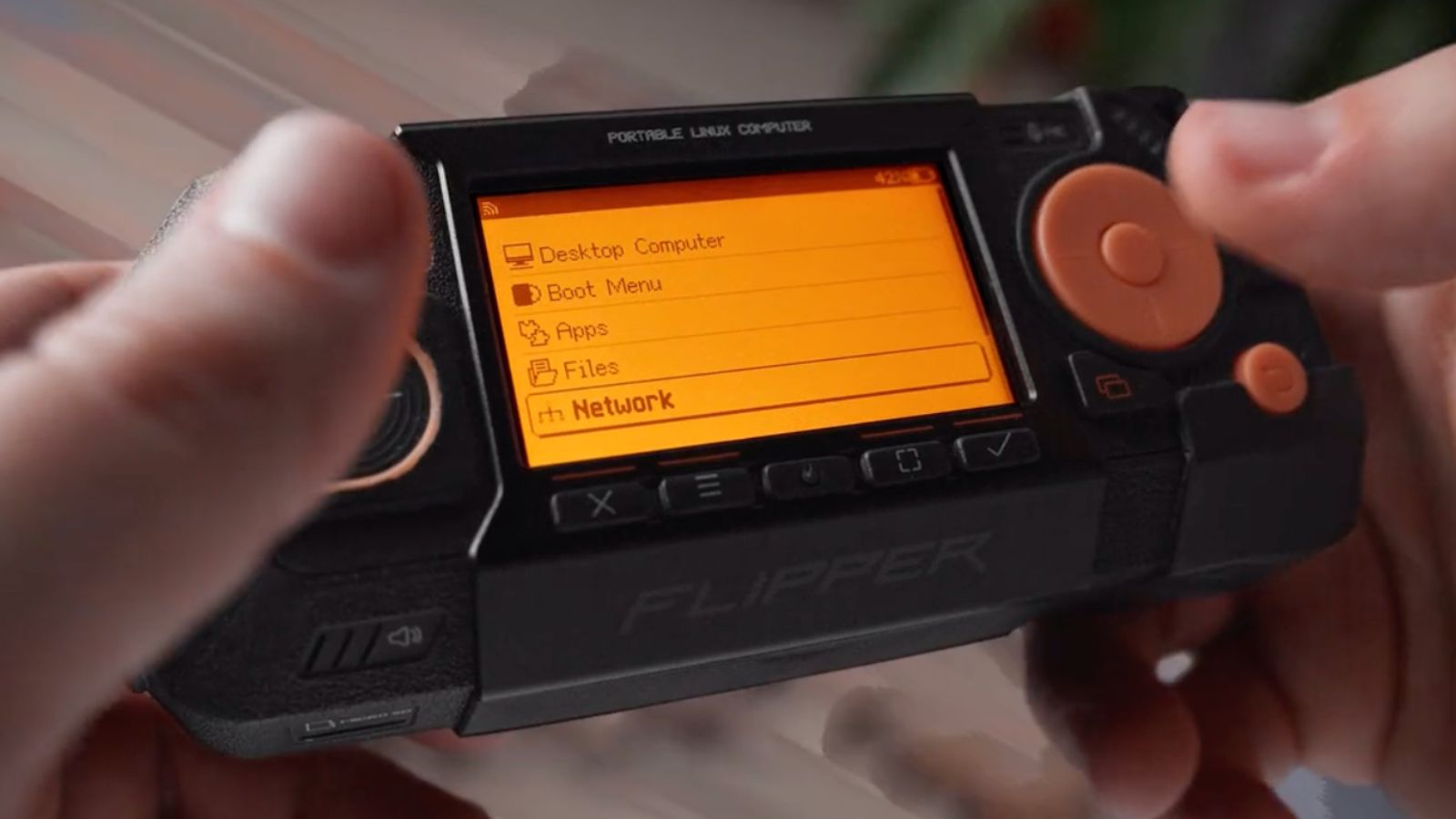
If you’re keen on the Flipper One, an “Open Linux Multi-tool,” you’d better hurry to nab the lowest possible price. The mini computer is currently being kickstarted on… well, Kickstarter, where it has blown way past its original $300,000 target. So far, the campaign has raised around $13.3 million. It still has 28 days to run.
The little cyberdeck design looks like it was ripped straight out of a William Gibson novel, but its feature set suggests it’ll have plenty of real-world utility. It’ll function as “a Network Multi-tool, Radio Lab, Home IoT Server, or Desktop Computer,” while various add-ons give it different capabilities.
Flipper One or another
Inside the Flipper One is a Rockchip RK3576 processor, a Raspberry Pi RP2350 microcontroller, and a monochrome 256 x 144 display. That gives users a very retro appearance, but also keeps the One power-efficient. A selection of ports around the PC/ABS body gives it the ability to connect to just about anything. Buyers can expect two USB-C (one is seriously multifunctioned), a USB-A, and a full-sized HDMI.
There are also dual Ethernet ports, a GPIO slot, a 3.5mm audio jack, and spaces for microSD and nano-SIM additions. Accessory expansions are possible via M.2, and WiFi, Bluetooth, and an internal battery are included. Battery capacity isn’t final — it’s estimated at 7,000mAh for now — and RAM also has yet to be locked down. But it’ll all come with a 64GB microSD card.
Depending on what you need it for, the Flipper One’s Kickstarter has multiple options that come with expansions included. If you need a LoRA setup, a 5G modem, or a software-defined radio option, those are available out of the box. The priciest option, at R13,150, includes all of them. The basic version will run you around R7,000 or $400, but only through the Kickstarter campaign. It’ll normally cost R8,600 ($550) on its own.
Here’s where the Flipper One gets tricky. The campaign only ships to certain countries, mostly North America, Asia, the EU, and the UK. The Southern Hemisphere coverage only includes Australia. Its creators also explicitly won’t “ship to freight forwarders or package forwarding services in the US.” A little creativity will be needed to secure one here in South Africa.