

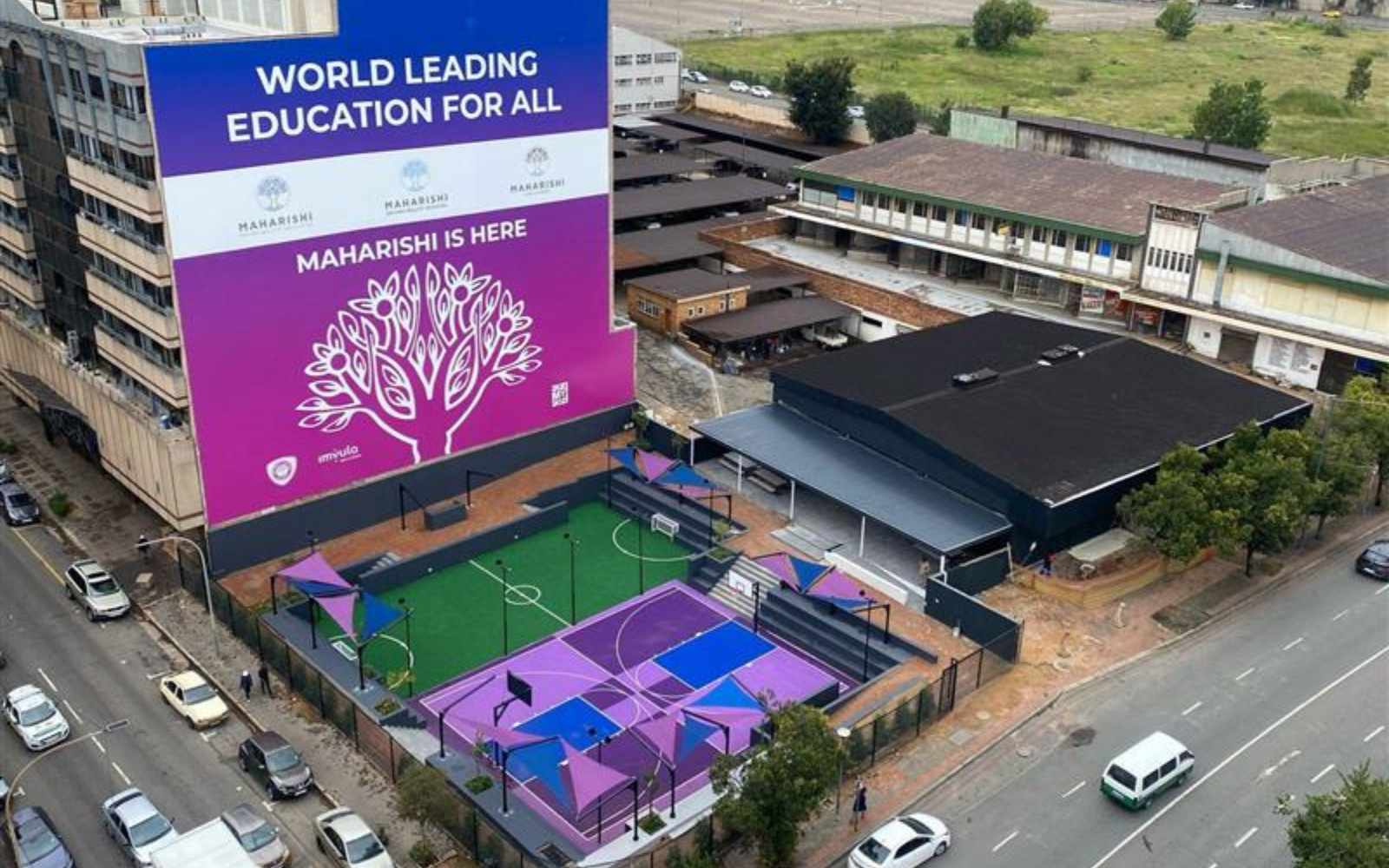
Nearly 20 years after first renting the auditorium at 56 Main Street in Marshalltown for his then brand-new inner-city education project, Dr Taddy Blecher bought the building. From a fledgling initiative with the lofty aim of educating 100,000 underprivileged children, Blecher and his utterly remarkable Maharishi Invincibility Institute are 25% of the way there.
Scaling education to transform Johannesburg
“We’ve educated 25,595 young people, 70% of them are women, so we’re now one quarter of the way to our goal,” Blecher said at the launch of a new initiative a few weeks back.
“But the most important part is that we got 22,567 of those formerly unemployed people into quality jobs; earning – if you add up all these starting salaries combined in their first year of working – R2.26bn per annum going back into those families,” he added. “So, education changes lives.”
This translates into 175,000 family members being supported by those “brand-new salaries,” says Blecher, who was a young actuary when he had the idea for what would become the wonderfully named Maharishi Invincibility Institute. “If our graduates never get a salary increase, and they just work until retirement, they will conservatively earn over R82.95 billion in their working careers.”
And his good work hasn’t gone unnoticed. Stanford University recognised Maharishi as one of the 12 most innovative educational institutions in the world. “Bold visionaries continue to shed the constraints of what higher education has traditionally looked like; they are creating radical new models increasing access for a more diverse set of students, enabling them to better bridge the academic institution and the world they enter after graduating,” Stanford wrote in its 2025 Reimagining Higher Ed report.
Blecher recently took the wraps off the next evolution of this self-funded education success story. Apart from unveiling the purchase of the building that used to house the Labour Department, he announced a tie-up with another hugely successful South African entrepreneur.
David Frankel was a young engineer who founded South Africa’s first internet service provider (ISP), which was sold to then-Dimension Data for R400 million. Frankel went on to study in America, where he started the Founder Collective investment firm, which provided seed funding for Uber, among other high-profile deals.
Frankel is the other famous South African innovator that nobody knows about, after Mark Shuttleworth and Elon Musk. Intelligent and quick-witted, he is low-key and down-to-earth in a way not associated with Silicon Valley royalty – as is his equally successful wife Tracey, herself a Baragwanath Hospital-trained neurologist.
Their philanthropic venture NextUp is teaming up with Blecher to create the Maharishi NextUp Institute of Technology (MNIT). Tech firm Altron has signed on as the anchor tenant for the initiative, which will focus on tech and digital skills. These include learning about AI, robotics, and automation, as well as accredited courses in cybersecurity and digital skills such as cloud engineering, digital design, digital marketing, and data science.
“Mr B, as he is affectionately known around here, is simply one of the most exceptional entrepreneurs we have ever met,” Frankel told a launch event at the 10-storey building he provided the funding to buy last year. “We are here to throw another log on the bonfire,” he said of the investment. “This is a real moonshot.”
Indeed, says Frankel, “we believe in a future where Johannesburg becomes one of the pre-eminent tech capitals on the continent. By providing this permanent infrastructure and nurturing the set of cutting-edge programmes coming in here, we are confident we will see youth trained as future tech leaders who will drive forward South Africa’s digital economy.”
Blecher’s vision is just as bold. Along with Maharishi’s original neighbour building – “you can’t miss it from the highway”– and now having bought 56 Main Street, he plans to turn the CBD into the educational haven for youngsters and a more hospitable place he’s calling Education Town. He has already overseen the building of the first full-sized football field in the CBD in a century and a new security academy, whose students patrol the nearby buildings.
All of this is happening alongside Jozi My Jozi, another initiative to reclaim the inner city and highlight all the good work being done by entrepreneurs.
Jozi My Jozi – which is backed by Anglo American, Standard Bank, ABSA, iqbusiness, Nando’s, and Wits – was co-founded by Nando’s founder Robbie Brozin, who has brought his renowned energy and leadership to resurrecting the City of Gold.

Blecher says the city has entered its Joburg 2.0 phase, which he identifies as post-1994.
“Joburg is not dying. Joburg was waiting, waiting to be reimagined,” he said, passionately arguing for the “new Joburg 2.0”.
It’s hard not to be swept up in Blecher’s enthusiasm – as Altron, the Frankels, and other companies involved show. For nearly 20 years, he has thrown his heart and soul into what is now a beacon of hope for so many youngsters, two of whom MC-ed the launch event and shared their personal stories. Both young women explained how they were not only unemployed but directionless until they studied at Maharishi. Both are now gainfully employed as cybersecurity officials at big banks and support their own families.
Blecher sees it as a calling to educate underprivileged children, while uplifting his home town.
“Who would have imagined that growing up in the city, for many of us, that this would be our job one day – on our shoulders – and what a joy to rebuild Joburg.”
- This column first appeared in Business Day