

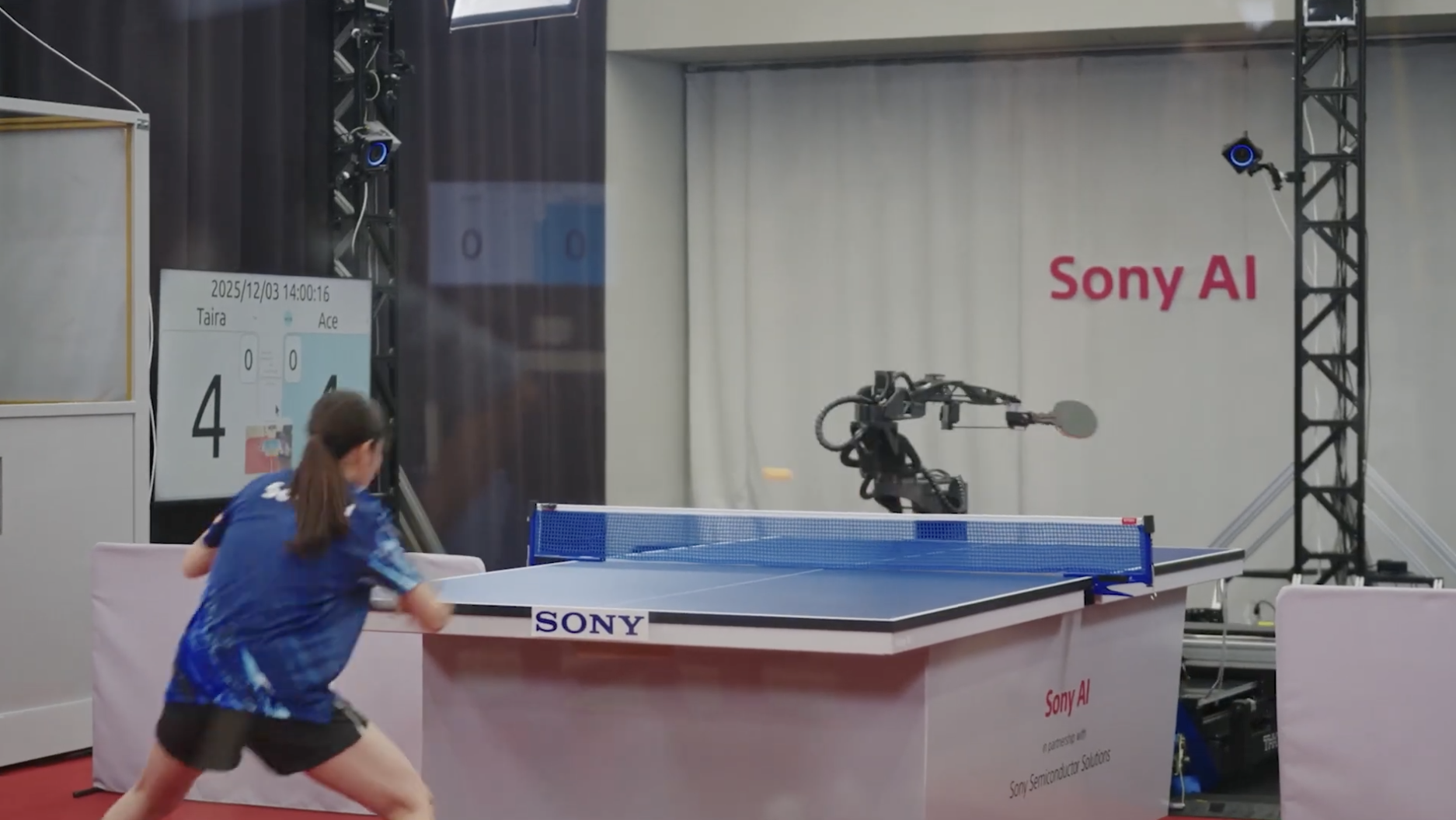
Robots have handed human runners a spanking, and now it’s the ping-pong folks in the firing line. Almost literally, in the case of Sony’s Project Ace robot. Unlike Honor’s Lightning, Sony’s robot isn’t a humanoid. It’s unlikely to run down a road whacking people with a table-tennis paddle any time soon.
From a showcase video Sony released on YouTube, its Ace robot has more in common with your everyday printer (3D or paper) when it comes to its operation. A high-speed arm zips back and forth on its side of the table, returning balls to a human opponent with extreme precision.
Table tennis rockstar
The robot benefits from high-speed cameras, an AI-based decision-making system, and similarly rapid components. Sony’s explanation is a little more detailed.
The company says that Ace utilises “a perception system capable of measuring spin on an unaltered ball in real time, a reinforcement learning architecture trained entirely in simulation and transferred to the physical world, and a custom-built robotic arm optimized for high-speed, repeated impact.”
If you need anything even more specific, the paper published in Nature will sort out any further questions. Watching the above video is less academically dense, of course.
It’s not just about hitting a ball back and forth, obviously. Peter Dürr, one of the authors of the Nature paper, explains that Ace “suggests that similar techniques could be applied to other areas requiring fast, real-time control and human interaction – such as manufacturing and service robotics, as well as applications across sports, entertainment and safety-critical physical domains.”
The robot has the potential to get better at what it does, says Sony. At present, because it’s trained via a simulator instead of on footage, it “reacts differently from human players and creates surprising situations.” That’s a strength, but human creativity means it’s also a potential weakness. Still… let’s put two of them in action against each other. Let’s see how long they can keep a volley war going.