

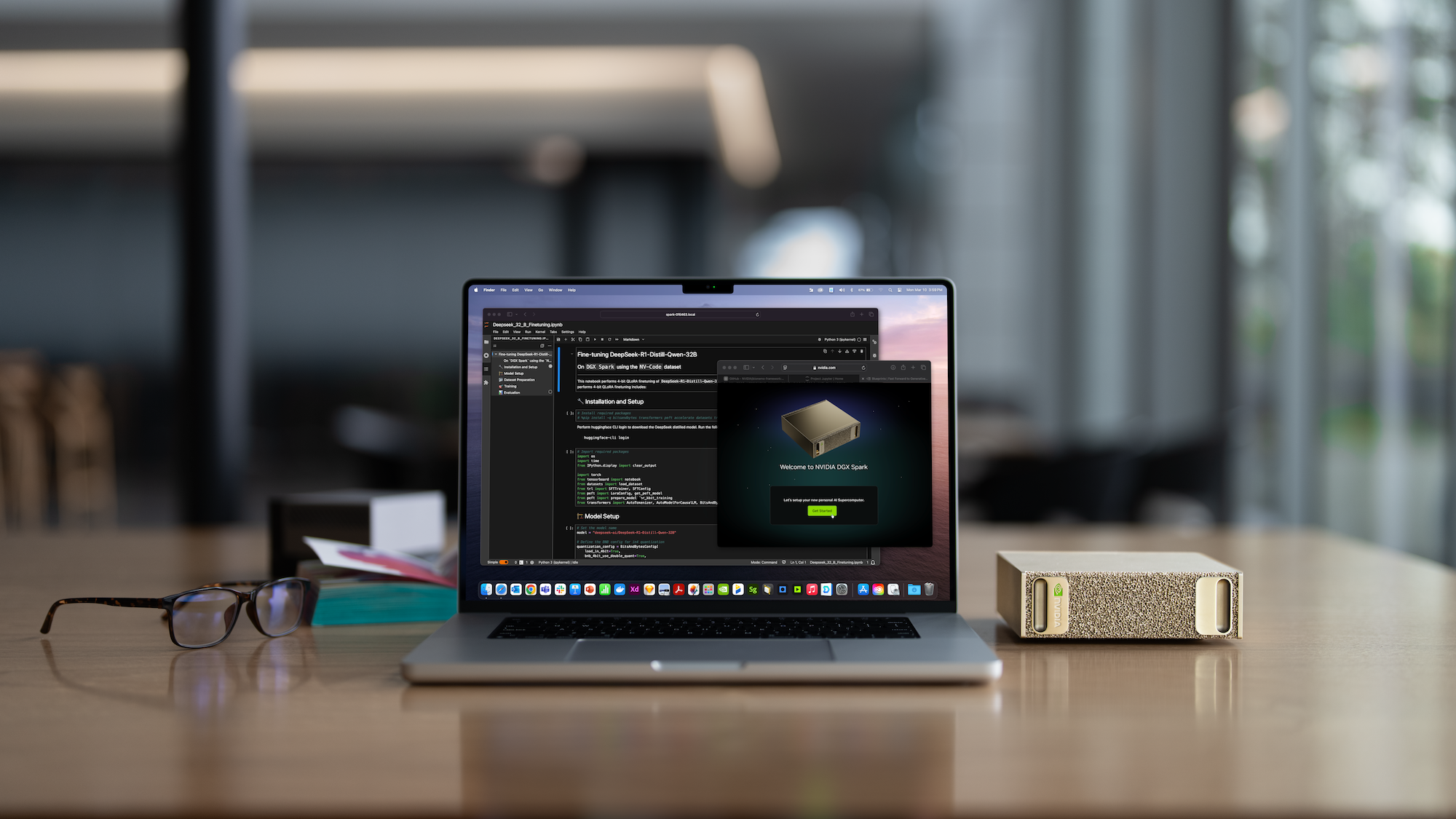
No matter what you think about the eventual trajectory of artificial intelligence, there’s plenty of noise being made in the space. Smaller developers can make some noise of their own by chucking one of Nvidia’s DGX Spark desktop “AI supercomputer” units into their workflows when they go on sale on 15 October.
Nvidia calls it “the world’s smallest AI supercomputer” and, based on the visuals we’ve seen, the company probably isn’t wrong. Despite its size, the company reckons it has enough power to run inference or fine-tuning of AI models without resorting to someone else’s compute. It’ll also allow “developers [to] create AI agents and run advanced software stacks locally.”
Bright DGX Spark
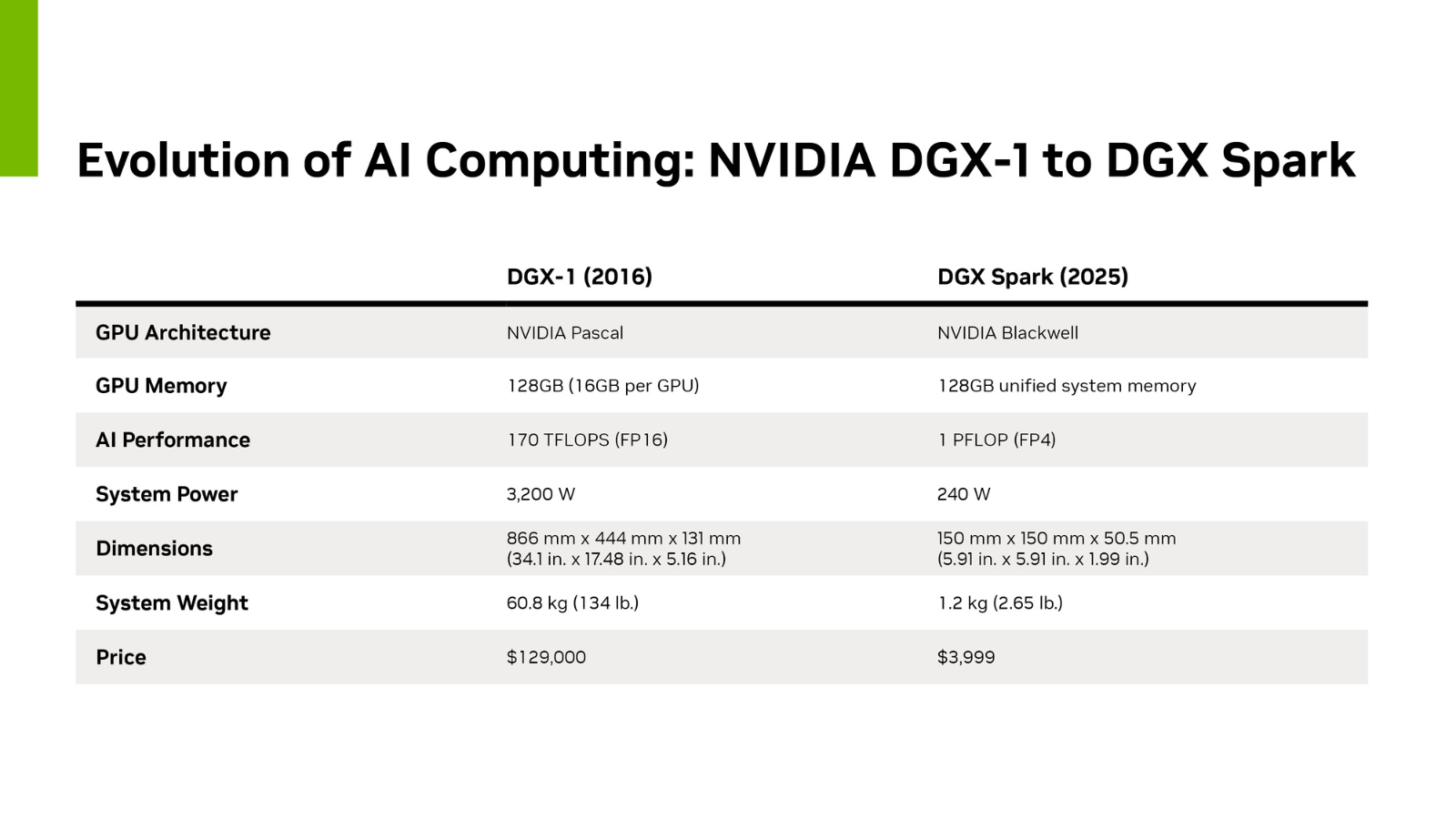 Regardless of the usefulness of AI, the DGX Spark is packed with the sort of hardware Nvidia is now most famous for. A petaflop of performance, powered by a GB10 Grace Blackwell superchip, 128GB of CPU-GPU coherent memory, and backed by Nvidia’s 200MB/s ConnectX-7 network and NVLink-C2C tech, means it should do what the company claims it does. The hardware has never really been the problem, of course.
The little box has Nvidia’s AI software stack preinstalled, letting buyers access “AI ecosystem tools including models, libraries, and Nvidia NIM microservices, enabling local workflows such as customizing Black Forest Labs’ FLUX.1 models to refine image generation, creating a vision search and summarization agent using the Nvidia Cosmos Reason vision language model, or building an AI chatbot using Qwen3 that is optimized for DGX Spark.” If that makes no sense to you, you’re just the end-user for folks who are keen on the purpose-built computer.
Read More: Nvidia becomes the first company to (briefly) pass a value of $4 trillion
At R70,000 ($4,000), you’re never going to buy one to see if it can run Crysis (it can’t, but you could probably convince it to), but it’s a far cry from the price tag attached to the first version, the DGX-1. That one shipped in 2016, priced at R2.25 million, and Nvidia head Jensen Huang credits it with starting OpenAI as an entity. Thanks, Jensen. Really. Words can’t express what the world owes you.
“In 2016, we built DGX-1 to give AI researchers their own supercomputer. I hand-delivered the first system to Elon at a small startup called OpenAI — and from it came ChatGPT, kickstarting the AI revolution,” said Huang, adding, “DGX-1 launched the era of AI supercomputers and unlocked the scaling laws that drive modern AI. With DGX Spark, we return to that mission — placing an AI computer in the hands of every developer to ignite the next wave of breakthroughs.”