

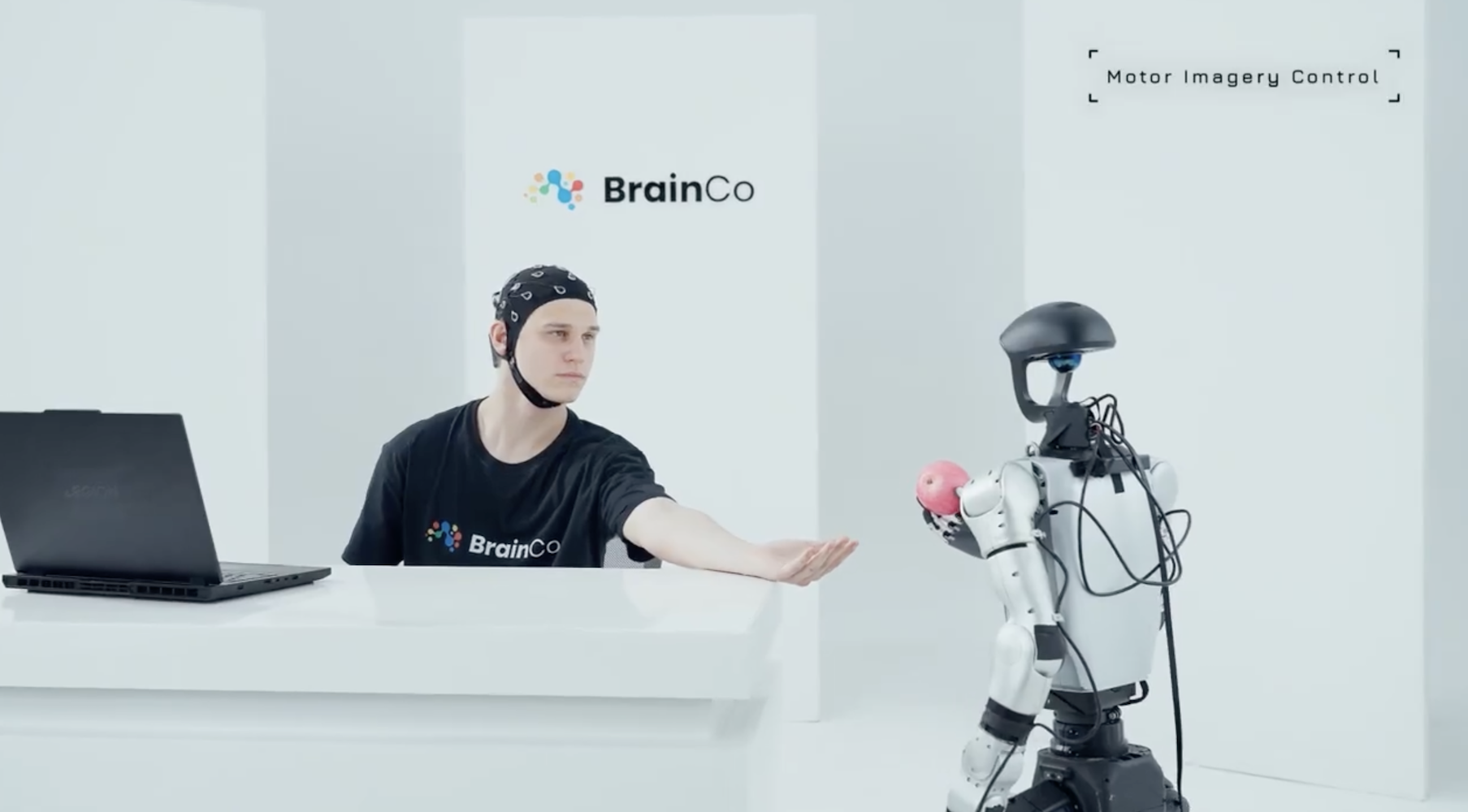
A company called BrainCo (guess what they do) demonstrated a human-robot interface at last week’s World Artificial Intelligence Conference hosted in Shanghai. The tech allows a human being to control various robotic platforms — a robot hand and an entire humanoid — using the power of their mind.
‘Mind’ isn’t exactly accurate, though. It’s more about brain power, thanks to the company’s EEG headset. The headset reads brain patterns, sends them through an AI-powered software platform, and translates thoughts into commands.
Use your BrainCo
Introducing BrainCo’s Brain-Controlled Robot AI Platform — the world’s first integrated AI R&D platform for brain-to-robot research. Unlock brain-to-robot control in just 10 minutes. No BCI background required.#BrainCo #BrainControlledRobot #BCI #EmbodiedAI pic.twitter.com/lP8uni98FR
— BrainCo (@BrainCo_Tech) July 16, 2026
The company says that it takes just ten minutes to “[u]nlock brain-to-robot control.” The company’s demo used a company representative to control a standalone robotic arm. The arm was able to pour and pass drinks and hand food to the user. BrainCo’s demonstration continued with a full humanoid robot, which performed similar tasks at a distance.
Some of the tasks the brain-to-robot interface will supposedly handle are the same as those exhibited by so-called household robots. Most of those, as expensive as they are, kinda suck right now. More complex tasks are being handed off to telepresence handlers. That causes privacy issues. Sticking a BrainCo interface into the mix cuts out the middleman. At the very least, it’ll mean there isn’t a stranger peering around your home.
It’s not like brain-computer interfaces are new. Neuralink has put its eggs in this particular basket for some time, though it is targeting more permanent, surgery-enabled solutions. BrainCo’s effort, which translates commands through its AI, is considerably less invasive. That said, a live tech demo can’t give anyone a full idea of what’s possible. Few companies will offer the blooper reel to potential customers. But the tech strongly suggests what may be possible when humanoid robots and human beings work together.