


If you want 'good' sound and have a limited budget, the DT 270 Pro from Beyerdynamic are worth investigating, with their construction and performance punching above their weight. But we'd recommend trying them on first, or buying from somewhere with a good return policy, as these might not fit your ears the way you like.
-
Design
-
Sound
-
Value
We like flagship products as much as the next person (maybe a little more), but we can also appreciate that not every product gets to be one. Along with the flagships, brands also need the more accessible. That’s what Beyerdynamic is aiming for with the DT 270 Pro.
These closed-back, kinda-over, kinda-on-ear headphones forgo high-end features to bring Beyerdynamic sound to more people. Maybe you don’t need active noise cancelling or in-app EQ. Maybe you just want a pair of headphones you can plug into your instrument or editing device — whether that’s your PC, laptop, smartphone, or recording desk. The DT 270 Pro offers all that, with a few small extras to help you get there.
With a recommended price of R3,000 (marked down to R2,550 at the time of writing), they’re pricier than the headphones you’ll find in Clicks. But they also sound substantially better and sport enough of a feature set so you don’t feel like you were cheated. If you’re looking for decent audio performance at an accessible price, these should be on your list.
Sturdy build
 The DT 270 Pro’s plastic construction isn’t the prettiest, and might give the impression of a cheap product. That changed once we got them out of their box; we were pleasantly surprised by how sturdy they felt. The plastic’s matte coating also means fingerprints don’t linger. The earcups can swivel in one direction, allowing them to lie flat. But that’s all the motion you’ll get out of these before something cracks.
The soft velour earpads and pleather headband padding can be rather comfy during long sessions, although the DT 270 Pro’s moderate clamping force might mean those sessions aren’t as long as you would’ve liked. After a few days of use, they relaxed a bit to the point where we can now use them for most of the working day without discomfort. We’re still not convinced by the earcup’s strange circular shape.
Unless you’ve got tiny circular ears, the bottom of the earcup will likely sit on part of your ear (it was the lobes for us). This doesn’t have to be a dealbreaker. The clamping force and passive isolation the earpads provide are good enough if you are somewhere quiet, like your bedroom. They let quite a bit through in a noisy office, however, which might get in the way of editing quiet sections.
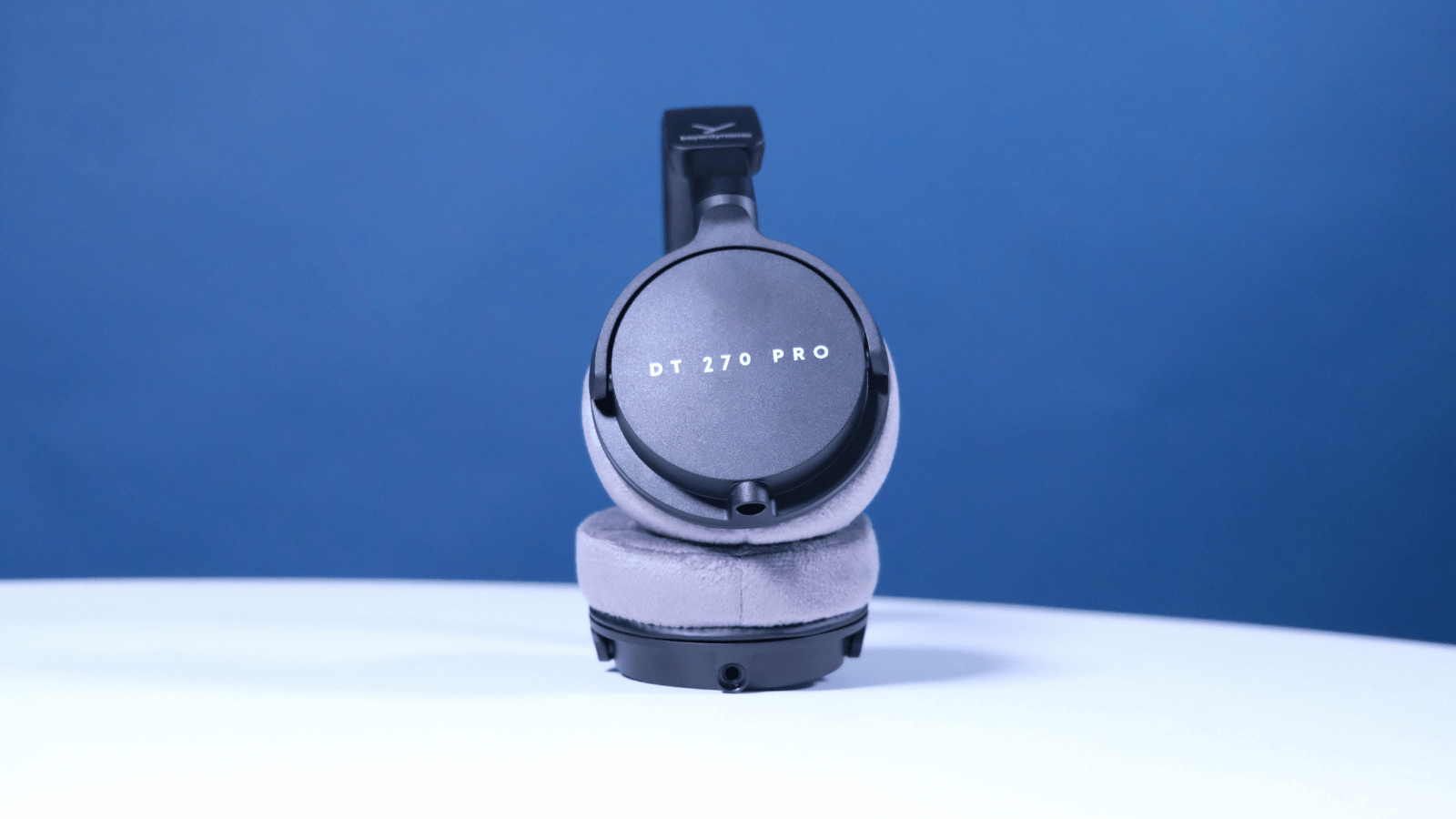 In the box, along with the headphones, you also get a partially coiled cable that could be swapped out for one of your favourites (you guys have favourite cables too, right?), a 3.5mm to 6.35mm adapter, a 3.5mm to USB-C adapter, and a drawstring pouch to hold everything.
That USB-C adapter, together with the DT 270 Pro’s low 45-Ohm impedance, means you can plug these into just about any source, and they’ll sing. If that source has more oomph to give them, like a headphone amplifier would, all the better.
You might be wondering about the mention of ‘Pro’ in the name. In Beyerdynamic parlance, that denotes a few things, like the replaceable earpads and headband. It probably also refers to the fact that you can plug a cable to either the left or right earcup. That’s not a feature we see too often and adds to the versatility the DT 270 Pro provides. Unfortunately, the dual entry does not mean these are compatible with balanced outputs.
Brass, strings, the whole toot
We went in expecting a balanced, neutral sound, seeing as these are marketed towards aspiring audio professionals, and bear “Balanced sound profile with high detail resolution” on the box. We got that… mostly.
First up was 23 from Shadow Child and Tymer. This low-end-heavy EDM track showed off what these headphones can do in the low end superbly, but exposed their energetic tuning from the start. Poem of Chinese Drum features a variety of drumming on the lower end of the frequency spectrum. It sounded great on the DT 270 Pro. That’s not to say the bass response was ever excessive or exaggerated. It sounded deep, present, and tightly controlled to our ears. But that wasn’t true for every track we listened to. They struggled a bit with the Versa Version of Tubby Isiah’s Bring Me Fire.
 When a headphone presents an energetic low-end, that’s usually accompanied by recessed mids and an overemphasis in the highs, resulting in a V-shaped tuning. That was not the case with the DT 270 Pro. The mids came across as clean, well-controlled, and decently balanced (if a little forward). Whether it was Chris Jones’ warm vocals in Long After You Are Gone, or Diana Krall’s in the soothing How Deep Is The Ocean, the mids were open, calm, and displayed good separation from the lower end with a good amount of detail. They didn’t leave the biggest impression, but they also didn’t muck anything up either.
Beyerdynamic has a tumultuous relationship with treble. In audiophile circles, they are often cited as having overly piercing highs that can become fatiguing quickly. To our surprise, the DT 270 Pro doesn’t follow older generations. Its highs, like the rest of its presentation, are controlled, have ample detail (see Yosi Horikawa’s Fluid), and (usually) lack a harsh edge. That said, push the volume up, and Billie Jean will hurt after a while.
Beyerdynamic DT 270 Pro verdict
We left our review time with this set of Beyerdynamic cans feeling a little confused. On the one hand, they offer a decent build quality and sonic performance for what they cost. Their versatility is their greatest strength. Anyone looking for relatively inexpensive headphones they can stick in their bag and plug into their phone or laptop could do far worse than the DT 270 Pro.
On the other hand, the marketing towards aspiring mixing and mastering professionals feels slightly odd given their tuning. They are perfectly fine if you’re messing around in FL Studio in your bedroom, using them to monitor your guitar, or just casually listening to music. But their energetic low-end could add more colouration to your mix than you want, if you’re not careful.