

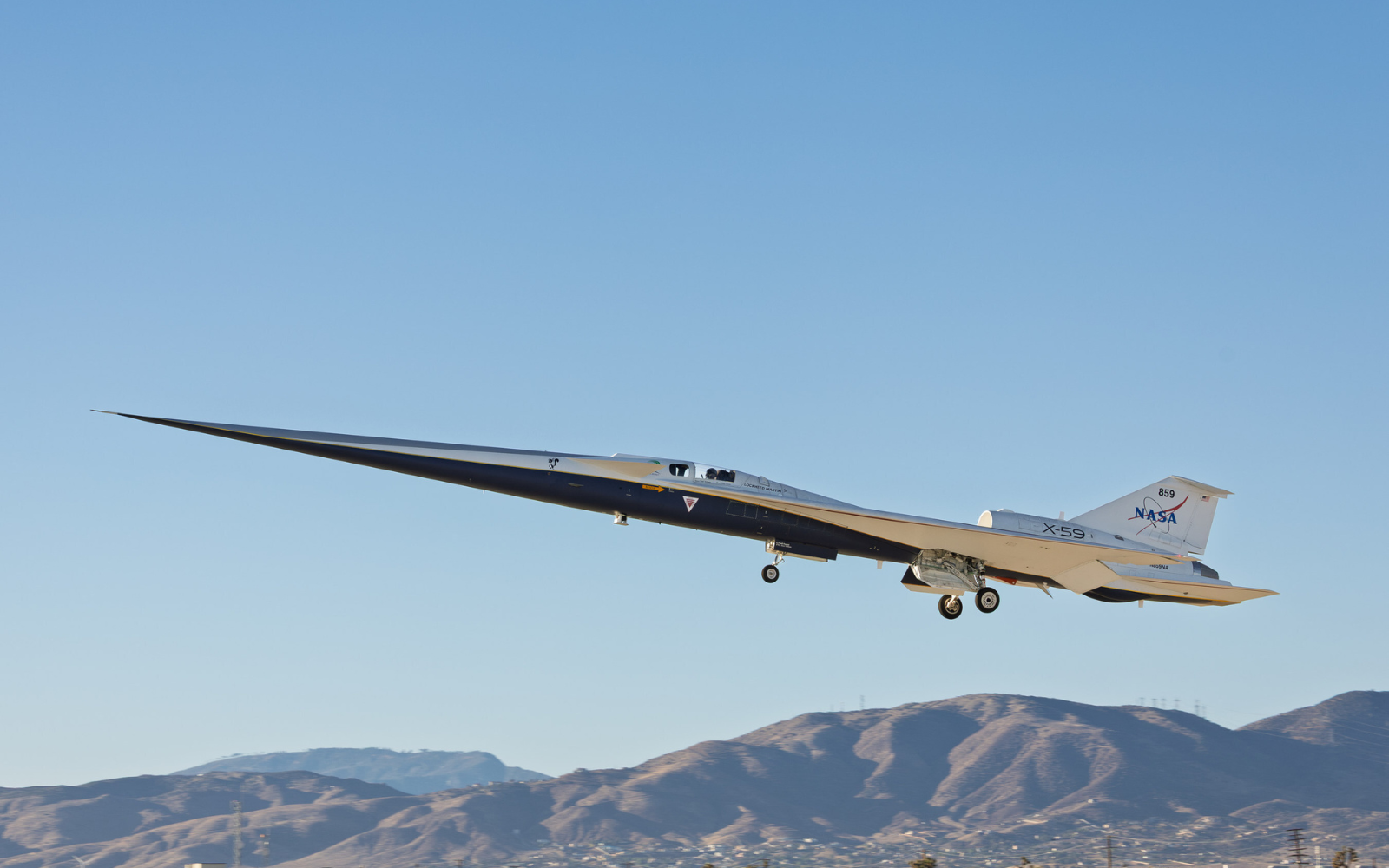
NASA’s experimental X-59 aircraft has blown past its next milestone just a short while after it went supersonic for the first time. Travelling at supersonic speeds isn’t that unusual. Doing so without creating a sonic boom — which makes these speeds a problem over populated areas — is.
Over the weekend (on Friday, 12 June in the US), the X-59 reached a new top speed and ceiling. According to the agency, these were “the conditions required for the aircraft to make future flights critical to its mission.”
Masking the X-59
The experimental craft reached a speed of Mach 1.4 (1,487km/h), more or less, at a height of 55,000 feet. That’s a fair jump on its previous trial. Last time around, it reached 1,147km/h at 43,400 feet.
While NASA is being fairly free with its performance specs, it’s the so-called ‘quiet thump’ that’s staying under wraps. For its trials so far, the agency has sent one of its F-15 supersonic aircraft to accompany the X-59. Part of it is monitoring the craft’s performance. The other part is explicitly to mask the sound it makes as it passes through the sound barrier.
“[F]or these early supersonic flights it has been accompanied by a NASA F-15 research aircraft, a traditional supersonic jet that causes booms obscuring any noise the X-59 makes. During upcoming flights, a shock-sensing probe mounted to the F-15 will gather measurements of the X-59’s shock wave signature, an early measure of its supersonic performance,” said NASA in a blog post.
Up next for the jet design is the acoustic validation phase, where the noise it makes is measured and assessed. Once that’s done, NASA “will fly the aircraft over several U.S. communities to collect data on public perception of the quiet sonic thump it will make at supersonic speeds.” The most recent speed and ceiling will form part of the public perception testing. Testing and assessment of the X-59 is expected to continue until 2029.