

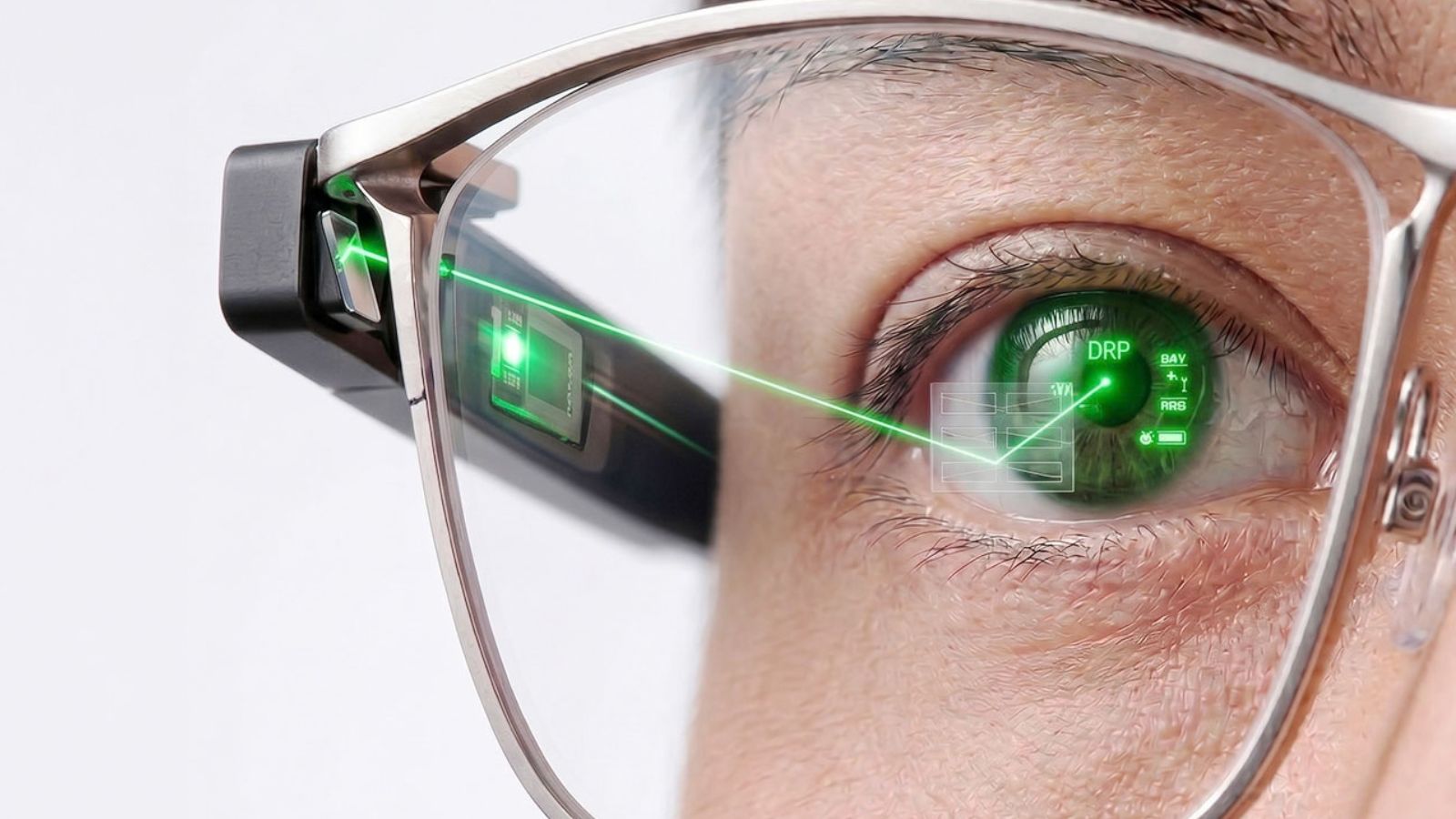
Smart glasses are edging ever closer to putting a permanent display in front of your eyes. TDK (yes, the company that manufactured cassette tapes) has demonstrated a very advanced version of this. The company calls it a direct retinal projection (DRP) display.
TDK’s tech uses something called a meta-optic mirror to project an image directly onto a wearer’s retina. That’s the core idea: an image is projected forward from the glasses’ bows, bounces off the meta-optic mirror, and enters the wearer’s eye. Best of all, it shouldn’t leave smart glasses users staring at a little embedded OLED panel all the time.
An eye on TDK
The principle behind the company’s DRP glasses isn’t unusual in optics. An image is emitted from a small laser, in this case an “ultra-compact full-color laser module (FCLM)” of TDK’s own design. It bounces off a mirror and onto the glasses’ surface. That’s where the meta-optic mirror lives, acting as the last link before the image enters the eyeball. What’s cool about it is that wearers probably won’t see the final mirror.
The meta-optic mirror is made of nanoscale reflectors, which are about as transparent as standard optical glass. In other words, the embedded section should be almost invisible to wearers. TDK’s laser, on the other hand, should have no trouble reflecting an image off that surface and into an eye. The result is a (for now) monochrome image visible only to the person wearing the glasses.
It’s a very cool concept, one that will be shown off at Japan’s CEATEC 2026 conference later this month. After that, expect a longer wait before direct retinal projection displays arrive. TDK reckons it will “demonstrate full-color operation and achieve mass production within the next few years.”