
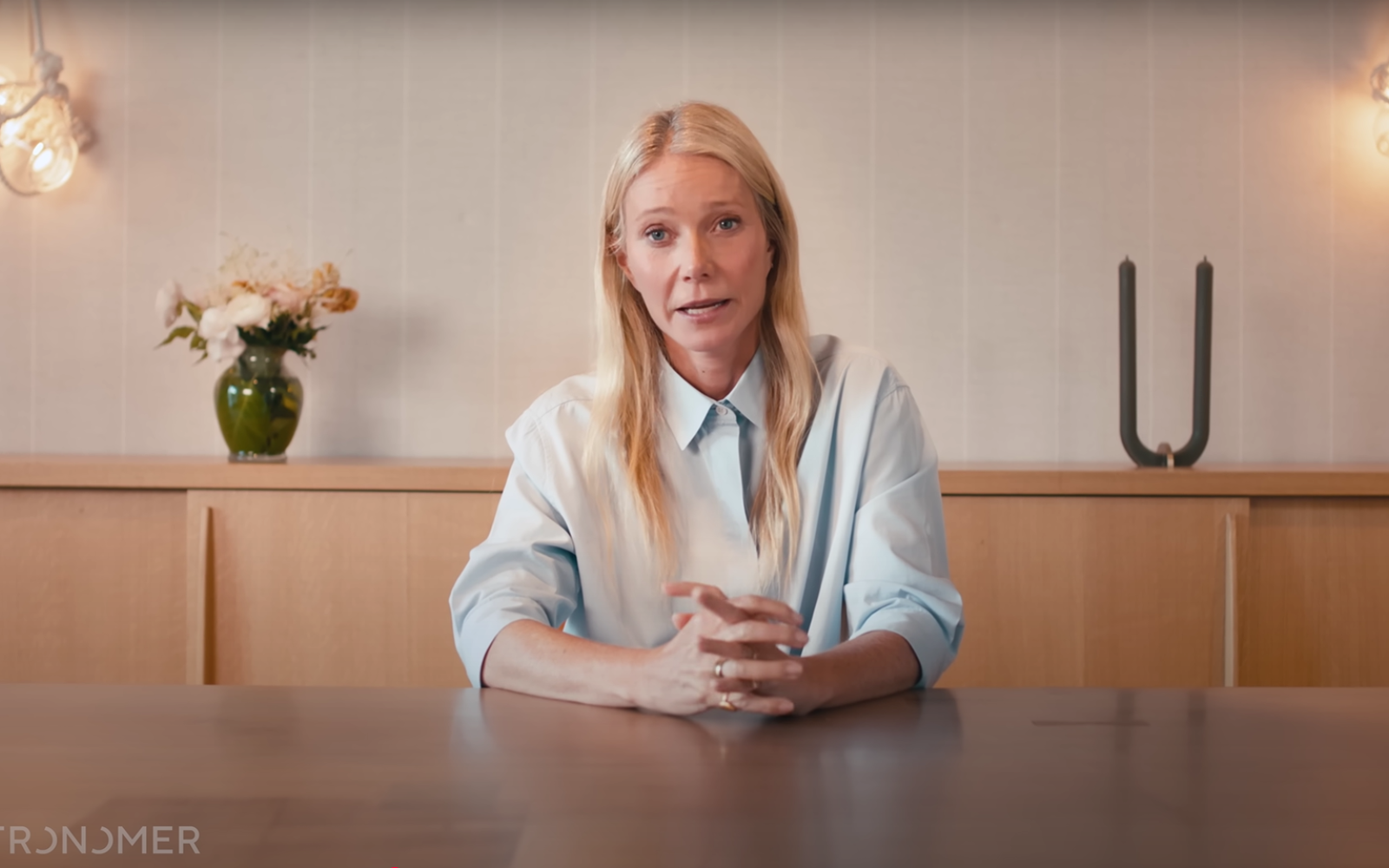
Hiring Gweneth Paltrow to be Astronomer’s spokes-celebrity after its CEO was humiliatedly outed for having an affair at a Coldplay concert is a pure stroke of marketing genius.
That Paltrow has been “consciously decoupled” (or, as the rest of us would say, divorced) from Coldplay frontman Chris Martin just adds spice to what is the social media story of the year so far. One always has to add “so far,” given how outrageous such occurrences are when they happen – this being the year of the Jeffrey Epstein revelations – you can’t help but fear we’re just getting started.
All Astronomer CEO Andy Byron and the company’s HR head Kristin Cabot had to do was stay still and not panic once the spotlight hit them. Instead, she hid her face, and he ducked down. Cue global intrigue and their spectacular fall from grace.
Astronomer, an AI firm nobody had ever heard of, has been gifted tens of millions of dollars of publicity that no marketing campaign can buy. And now it’s mostly in the news for doing the right thing. When’s the last time a big business made headlines for that?
Byron was surely pushed to resign, and the company’s response, especially in hiring Paltrow, has been what you would expect of a good corporate citizen.
Also, let’s admit it, it’s really funny – on top of what is already a humorous event. The memes that exploded all over the internet were truly hilarious. This is one of my favourite things about the internet; we have so much to complain about in the age of disinformation, toxic masculinity, and general social media nastiness.
Arguably the funniest of these was cartoonist Zapiro’s depiction of US President Donald Trump and sexual predator Jeffrey Epstein as the hapless Astronomer couple. In the role of Coldplay’s singer is a gleeful Elon Musk – who tweeted Trump was in the Epstein files during their very public break-up earlier this year. It’s sheer genius – as always from Zapiro, who is one of SA’s living treasures.
Human nature has a pressure release valve. It‘s called humour. The evolution of our ability to laugh at what happens to us – okay, usually at the misfortune of others, which was the origin of slapstick – has helped our evolution. It‘s a coping mechanism. Laughing at ourselves is a higher-level brain function, you could argue, and a symptom of our self-awareness. It’s how we cope.
Even in the darkest of moments, someone seems to say something irreverent or outrageous or just plain funny. There’s another thing about humour: it’s often the wrong thing to say – and that’s why it’s funny.
Our sense of humour allows us to say outrageous, potentially horrible things in a way that blows off steam and gives us one of the greatest things about being human: a good laugh.
Read More: Instapaper redux: Taking on PDFs
We could all do with a good laugh right now. It won’t make the 30% irrational tariffs imposed on SA by Trump – but at least we don’t have it as bad as the penguins on islands in the South Pacific.
At least we aren’t Eswatini – where factories are shuttered and whole families are unemployed. Is it too much to simplify this conundrum as: Americans will pay more for jeans while people starve in our neighbouring country?
These tariffs are sadly all based on an irrational supposition about international trade, which fails to take into account that most of the US’s exports are in the non-physical form of digital services. America’s biggest exports – certainly culturally – are social media firms, Netflix, Amazon and its Prime video service, and Hollywood.
Who is paying for those services? The consumers in the rest of the world.
There is a movement by the world’s telecoms operators to get the big streamers to pay more for their services, given how data-intensive streaming is. At every MWC Barcelona event I have been to in recent years, there are several executives of the big European telcos arguing that this form of heavy data traffic should be paid for by the streamers.
Good luck with that. The legislation around so-called net neutrality is there for a reason and is important. As soon as you judge one form of internet traffic over another, you create the same economic divides in the virtual world as exist in the real world.
As much as it’s obvious that the big streamers are the biggest users, if you start down the illogical path of paying for access to the internet, only the big businesses with the deepest pockets will win.
Imagine if all the entertainment you could find was made by an American company (Netflix, Amazon Prime, Universal, Peacock, HBO, Max, etc) and was free to access. But if you wanted to subscribe to a streaming service in your own country (think Bollywood, Nollywood, or Benoniwood), you’d have to pay more.
Local is lekker is the Saffa way of describing that people want to consume content in their language and their own country. Trevor Noah is always going to be funnier in SA and in Africa than Stephen Colbert because he’s one of us – as well as outrageously funny.
Why? Because he says the things many people think but don’t vocalise. That’s the role of a comedian – and generally speaking, of the arts. Society, by its very nature, needs a foil. I am named after Sor Toby Bletch, Shakespeare’s second-most famous foil after Falstaff.
Trevor Noah has a special place in South African hearts not just because he’s one of our greatest exports, but because he represents the best of our battered and bruised nation, who has found a way to laugh at ourselves despite our shortcomings. He’s also, arguably, the great foil in popular culture since Shakespeare. And the most inspirational and lovable.
South Africa needs more Trevor Noahs and fewer Cyril Ramaphosas to solve our problems.
- This column first appeared on Business Live