

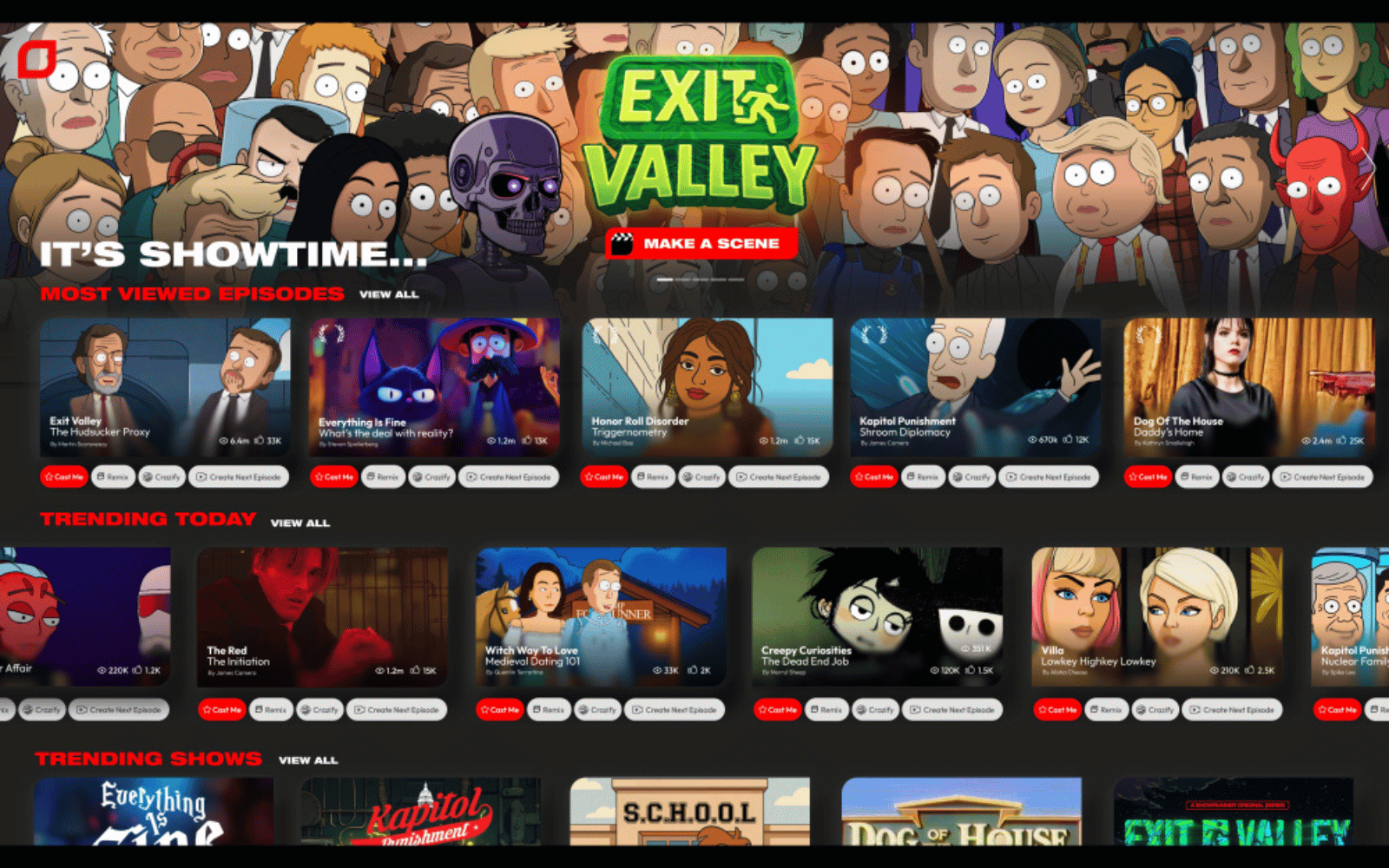
Showrunner, a new service that has just entered its alpha testing phase, claims to do what all those artificial intelligence fanboys reckon the technology would: let users create entertainment for themselves, via a prompt (or a collection of them).
Variety reports that fledgling startup Fable, headed by Edward Saatchi and partially funded by Amazon (though the amount of funding isn’t disclosed), will conduct an initial test of the service with 10,000 users. It’s not as simple as banging in your specifications and popping out a novel show — a function many users would immediately use to make pornography.
Who’s the Showrunner now?
The test — which is initially free for users — allows viewers to create customised TV shows based on a variety of art styles. Think Rick and Morty as force-fed through Sora or Runway, and you’re most of the way there. The changes viewers can make are based on these pre-defined styles and the Showrunner-created shows created using them, letting viewers direct the action in scenes as opposed to crafting new properties.
In theory, viewers could cobble together enough scenes to render entire episodes, with Saatchi saying that these creations can be freely shared on social media or YouTube. But they will eventually have a cost to create — somewhere in the region of $10 to $20 a month. This will buy credits used to create scenes, and Showrunner, we suspect, will probably implement a top-up system for folks who burn through their allotment quickly.
That’s assuming the AI-generated streaming platform takes off. Saatchi, who reckons “streaming services are about to become two-way entertainment”, seems at least realistic about his venture. “Maybe nobody wants this and it won’t work,” he adds.
Before you get too excited about the future of home streaming, it might be useful to look back at the NFT bubble. You remember, the thing that was supposed to alter the face of the art world forever? That could well happen here too, something Saatchi is familiar with. He was previously involved with Oculus Story Studios, which attempted to bring VR-based entertainment to the masses. That never took off, despite strong expectations to the contrary.
“In 2014, we said, ‘Everything will take off when this happens. And it didn’t work,” said Saatchi.