
Skild AI, a company backed by Amazon and Japan’s SoftBank, has unveiled Skild Brain, “a unified, omni-bodied brain to control any robot for any task.” It’s being touted as AI-driven, but that’s to be expected in 2025. A few years back, it would have fallen under the banner of machine learning. Still, the concept is a cool one.
Rather than focusing on a single robot’s functions, Skild AI’s software is an “omni-bodied foundation model, which can work on quadrupeds, humanoids, table-top, mobile manipulators, and more.” The idea of a unified robotics operating system has its attractions, since robots presently come in all shapes, sizes, and weapon loadouts.
Marvel at my Skild Brain
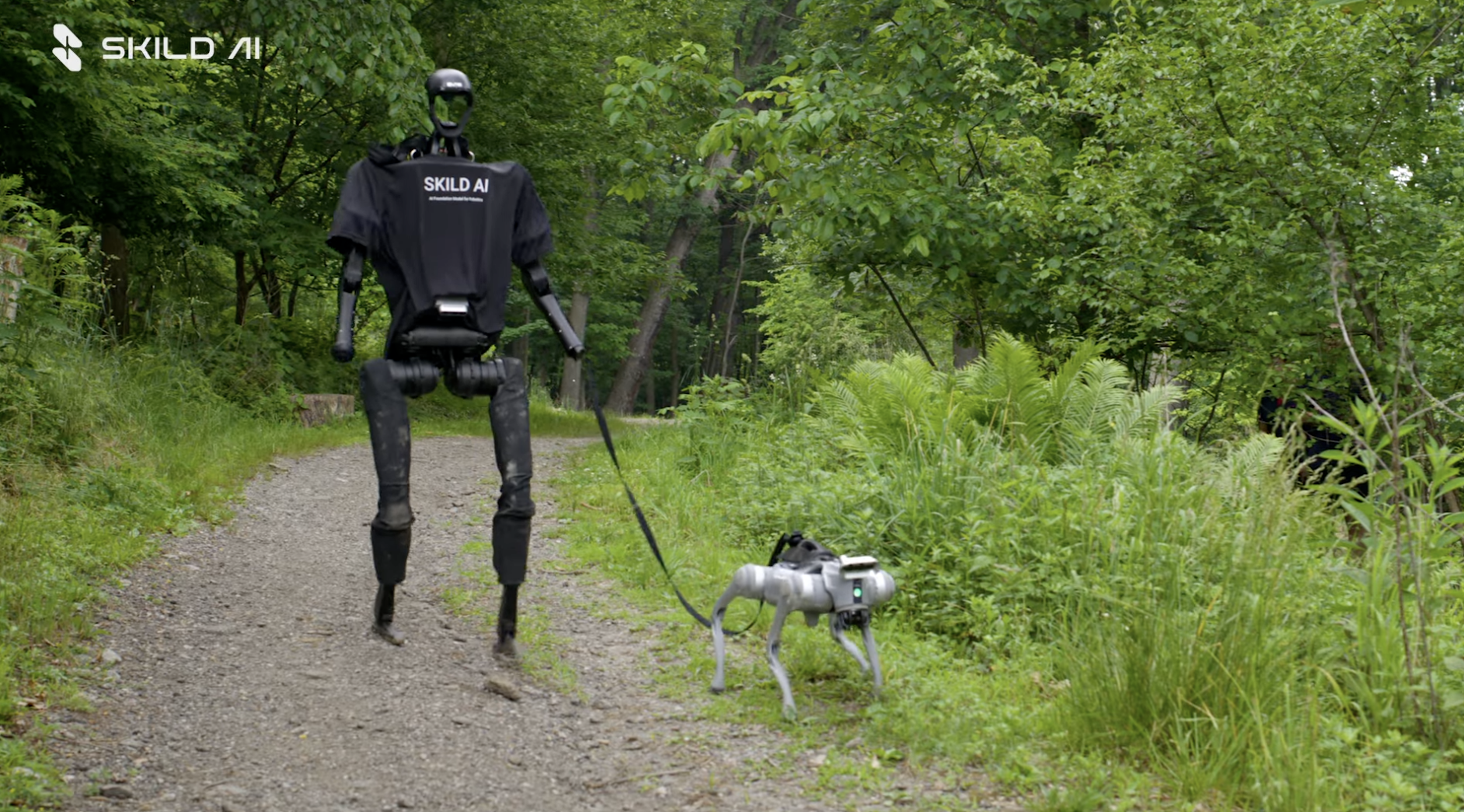
The company has released a demo video of Skild Brain in action, showing many of the main robotic archetypes performing dextrous tasks while wearing company merch. Wearing a Skild.ai shirt doesn’t confer any special abilities on the mechanical contrivances, of course. It’s the training method, which operates similarly to large language models (LLMs), that is supposed to make the difference.
Initially beginning as a vision-and-language model (VLM), the robots outfitted with Skild Brain constantly transmit updates to the central model, allowing the company to more quickly issue updates to other robots. If, for instance, a robot learns skills in a warehouse that can be applied elsewhere, the software controlling other robots can share those insights.
The reason given for this approach is that there’s precious little training data out in the wild for training robots. That’s why Skild AI is essentially crowdsourcing its training data, having initially trained its robots on simulated situations and videos of humans performing certain tasks.
CEO Deepak Pathak, speaking to Reuters, explained, “Unlike language or vision, there is no data for robotics on the internet. So you cannot just go and apply these generative AI techniques.”
Despite working on a multi-configuration solution for robot movement and skills, it still takes time to implement new abilities. Before they’re pushed out, Skild Brain must be “fine-tuned and distilled to meet deployment needs.” This might be code for ‘ensuring the best possible usage of the newly learned capability,’ or it could mean ‘we have to make sure your robot dog doesn’t think it has hands.’
At least the company has included power limits that should ensure its robots don’t accidentally use too much force. We’d love to know what happened to cause that feature to be specifically included. If Cyberdyne Systems was involved, we should probably be made aware of that.