

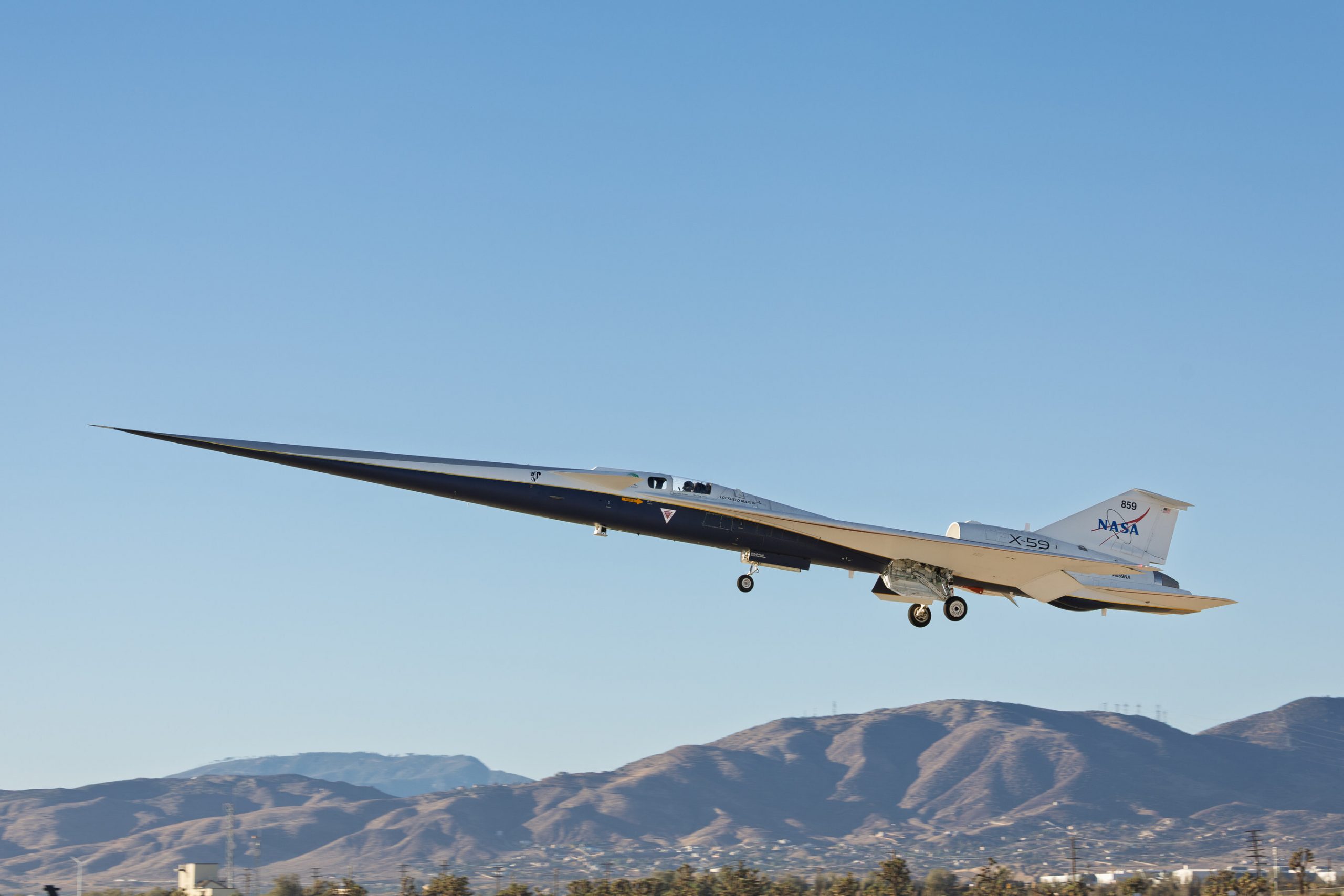
There’s something almost mystical about supersonic aircraft, but since the Concorde’s retirement in 2003, they haven’t spent much time in the public eye. NASA and Lockheed Martin’s new X-59 — the only designation for the Lockheed Skunk Works-made craft so far — could change that. The impressively pointy plane has just completed its first test flight.
The aircraft is intended to “pave the way for faster commercial air travel,” meaning it’s something of a spiritual successor to the British Concorde. There’s something unique about this one, assuming it scales up to carrying commercial passengers. It’s supposedly a “quiet supersonic aircraft.”
Silence: the X-59 is coming
That doesn’t mean you won’t hear the X-59’s General Electric F414-GE-100 turbojet engine, which is an evolution of the Saab JAS 39 Gripen multirole fighter jet‘s power plant, when it blasts off the runway. The ‘quiet’ part comes in when it breaks the sound barrier — the iconic ‘sonic boom’ will be muffled by the plane’s design, until it’s only about 75dB — Lockheed describes it as “about as loud as a car door closing.”
The jet’s design “separates the shock waves that produce sonic booms” to create this effect, even as it’s being pushed to a top speed of 1,490km/m. That speed would cut a flight from Cape Town to London from roughly twelve hours to a little under seven. Once the X-59 gets to its cruising altitude of 55,000 feet and really lets the brakes off, the time (and distance) should just zip by.
It’s not ready for passengers yet, obviously. NASA and Lockheed intend to “expand the X-59’s flight envelope over the coming months,” with the tests including the optimal altitude and speed to achieve its muffled sonic boom. Once those and other kinks are ironed out, the aircraft will head to its eventual goal of “efficiently and sustainably transport[ing] passengers and cargo twice as fast as aircraft today.”