
Unitree’s Stellar Explorer robot dog might be the stuff nightmares are made of, but a pair of others, along with a robot called Rollin’ Justin, have just put in a stellar performance of a different kind.
Two robotic canines, Spot and Bert, were recently tested in a joint effort that simulated a Martian environment. That robot dogs can traverse rocky ground is not surprising, but giving them commands and controlling their movements from orbit is another matter.
Robot dogs need space
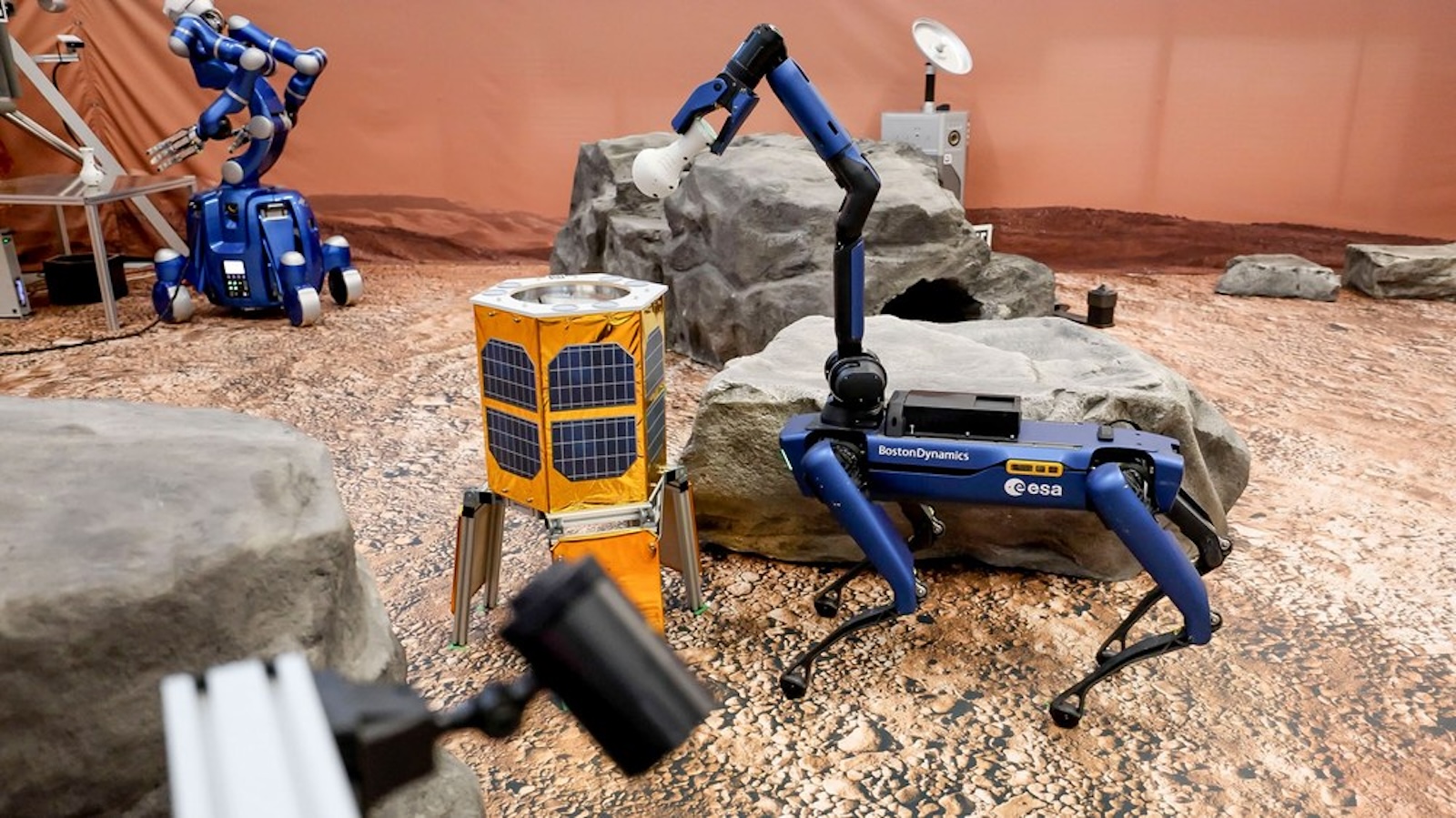
Four robots and a NASA astronaut on the International Space Station took part in the latest Surface Avatar test at the German Aerospace Center’s (Deutsches Zentrum für Luft- und Raumfahrt or simply ‘DLR’) Earthly Mars site. Surface Avatar is just what it sounds like — a way of adding a human presence to an extraterrestrial surface without risking human lives. Not there, at any rate.
NASA’s Jonny Kim remotely commanded the mission, directing Rollin’ Justin, Bert, and Spot — the only Surface Avatar newcomer — to collect samples from the simulated environment. The fourth participant was the European Space Agency’s (ESA) Interact rover, which joined Justin in trundling about on wheels instead of legs.
Spot was tasked with autonomously collecting samples from the region, while Rollin’ Justin loaded these samples and moved them to a transfer area. These tasks were accomplished with little input aside from the initial directives to get to work.
An exceptional bit of work was observed when the ESA’s Interact rover took robot dog Bert to a cave that needed exploring. An injury to one of Bert’s limbs was simulated, with the robotic quadruped’s internal ‘reinforcement learning’ systems being directed to compensate. NASA’s Kim trained Bert from orbit until a viable movement workaround was found and tasks could continue.
Helping Kim’s control over his robotic menagerie was Neal AI, a chatbot based on the Mistral AI LLM, which answered questions about the mission, control of the robot dogs and their companions, and the user interface the astronaut was tasked with controlling.
“Surface Avatar is a milestone in human-robot collaboration in space. We have now achieved all the technical requirements for controlling complex robotic missions on Mars – and for a future permanent lunar research station,” said Alin Albu-Schäffer, head of the DLR Institute of Robotics and Mechatronics.