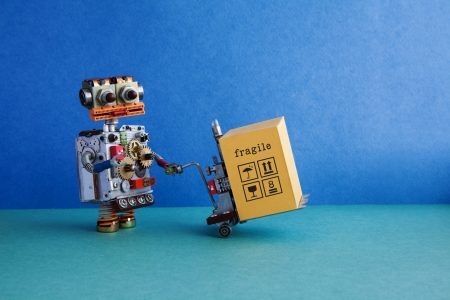
Your vacuum cleaner that you leave to do its job while you are away is a robot. It senses the world around it and makes driving decisions as it sucks and sweeps.
But your washing machine is not a robot. You tell it how to wash when you select the cycle and it gets on with it. There are grey areas and the definition is debated, but let’s leave it there.
Browsing: The Conversation
Uber’s upcoming initial public offering may be one of the biggest in history, with the ride-hailing company expected to raise up to US$9 billion.
That’s good news for its early investors and executives, who could reap $1.3 billion from the IPO.
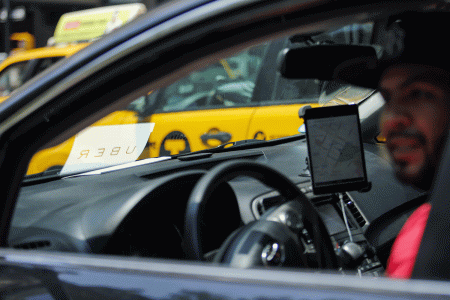
For the potentially hundreds of thousands of drivers who do it as their largest or main source of income? Not so much. That may be why some of them plan to go on strike in seven U.S. cities for 12 hours on May 8.
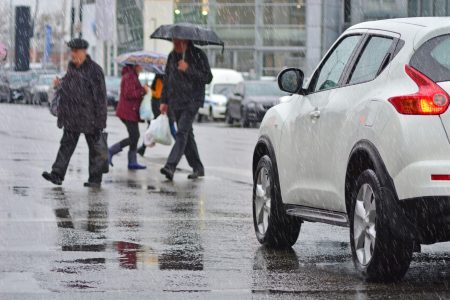
Rightly or wrongly, billions of dollars are being poured into autonomous vehicle research and development to pursue this autopia. However, barely any resource or thought is being given to the question of how humans will ultimately respond to the AV fleet. In a city full of autonomous cars, how might our behaviour and use of city streets change?
Urban planners, technology companies and developers are increasingly looking for ways to improve our lives and make our systems more efficient. If we continue to live as we have, polluting and making our air increasingly toxic, we may have to develop solutions like indoor tracks for dog-walking, à la the Jetsons. But is that what we aspire to become?
I wanted Green Lantern’s ring, Wonder Woman’s bracelets, Captain America’s shield and of course Batman’s batsuit. I never imagined then that 30 years later, as National Superhero Day approaches, I’d be designing components of my own supersuits.
Even in the wake of a recent mixed earning report and volatile stock prices, Netflix remains the media success story of the decade. The company, whose user base has grown rapidly, now boasts almost 150 million global subscribers.
Quantum mechanics is a branch of physics that attempts to understand and apply mathematical, verifiable rules to the behaviour of nature at the smallest end of the spectrum – on the scale of atoms, electrons and photons. It was first developed at the beginning of the 20th century, and has been very successful in describing systems on the microscopic level.
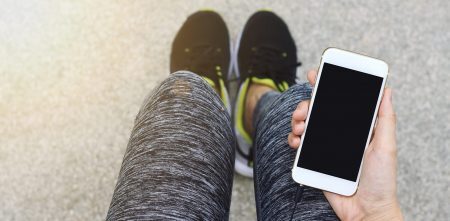
Of all screen-time enabling devices, smartphones are the truly ubiquitous ones, which in essence makes them tools of equity in the 21st century that provide access to billions of people around the world.
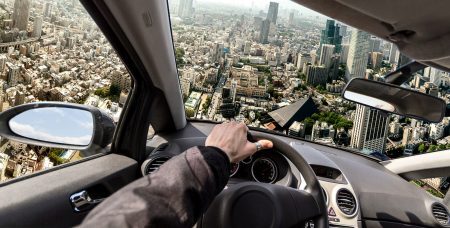
As Harry Potter’s encounter with the Whomping Willow reminds us, flying cars can be dangerous. Before futuristic visions of three-dimensional sprawling city traffic can approach reality, there are some serious safety issues that need addressing.
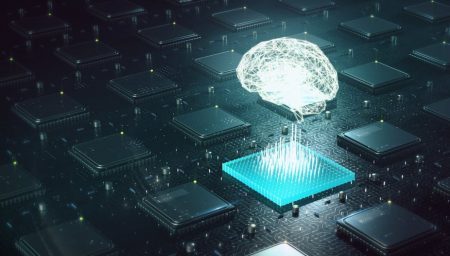
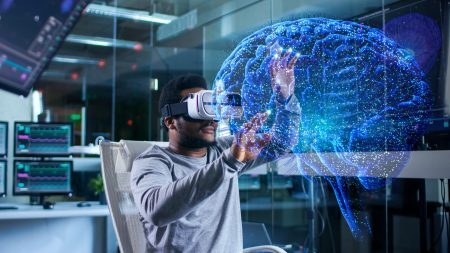
In our lab at the University of Saskatchewan we are doing interesting deep learning research related to healthcare applications — and as a professor of electrical and computer engineering, I lead the research team. When it comes to health care, using AI or machine learning to make diagnoses is new, and there has been exciting and promising progress.